
by Beverly McNeff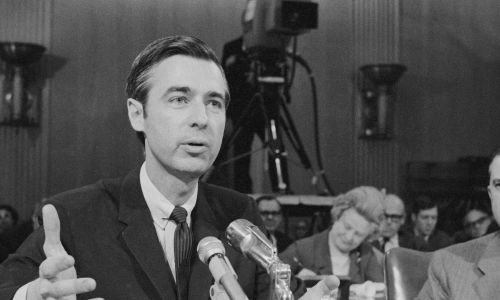
In 1969, the Nixon Administration was planning to cut the Corporation for Public Broadcasting’s (CPB) funding from $20 million to $10 million. Fred Rogers, the innovator of the highly acclaimed children’s television show Mr. Rogers’ Neighborhood, testified before the U.S. Senate in an attempt to save the funding. His heartwarming appeal and testimony on the importance of CPB for children’s growth and well-being not only saved them from the cut but also prompted the Senate to increase funding by $22 million.
That was then, and this is now. Last month, the CPB’s funding was not just cut, but decimated. As a result, it will close down. Wonderful children’s programming will disappear in rural areas all over the country. These areas will also lose the PBS News Hour, which, for many poor regions, was the only local news, weather, and disaster awareness connection they had. Cuts such as these, as well as the latest cuts to social services like food banks, after-school programs, Medicaid, and Veterans support, to name a few, will leave the poorest areas of our country without support and have already caused rural hospitals to close down in anticipation of the devastating effects.
Mr Rogers died in 2003, but his show, which first aired in 1968, is still being rebroadcast along with an offshoot of the show, Daniel Tiger’s Neighborhood. More affluent areas of the country will continue receiving valuable programming through the support of individual contributions to PBS stations. Still, it will no longer be a given that children in every corner of the country will have access to transformative shows like Sesame Street or Mr. Rogers’ Neighborhood, which is a sad commentary on our priorities as a country.
How would Mr. Rogers suggest we look at this current situation in the face of such attitudes toward those in need? Fred Rogers always carried in his pocket a quote given to him by a social worker that forever changed the way he looked at life. It read: “There isn’t anyone you couldn’t love once you’ve heard their story.”
Many people have recalled the power of this thought in Fred’s life, as he often referred to it. If friends would tell him about someone who had angered them, Fred would always say, “But I wonder what was going on in that person’s day.”
Instead of taking it as a personal affront, Mr. Rogers was inviting those people to look a little deeper – to the content of that person and not just the effect of their behavior. And we can do this without condoning their actions.
Focusing on the deeper issues that cause people to do terrible things is essential for a couple of reasons. First, if we are angry, appalled, or disgusted by a behavior, it only hurts us. Our focus cannot be on hate if we are to be truly helpful. Hate, attack, and any bullying are the behavior of those who see themselves as weak and lost, and we all need to recognize that. With that said, it does not mean that we should do nothing or approve of such behavior. If a child is running into the street or playing dangerously with scissors, they need to be stopped.
Given the recent developments and the consequences of these devastating actions, you may be wondering what you can do to be truly helpful. How can you deal with your feelings of anger and hopelessness without attacking or losing your real power?
In A Course in Miracles, we are asked to remember the truth of every Child of God, past their ego actions and personas. We are not asked to condone hateful actions, and in some cases, those actions may need to be stopped, but we can also meet them at the level of truth as God knows them and start affecting a transformation that will produce a healing outcome for us all.
Our goal needs to be remembering who and what we truly are. We believe we are anything but God’s eternal, limitless, and guiltless child. And yet His opinion of us has never changed. As we read in A Course in Miracles,
“God does not change His mind about you, for He is not uncertain of Himself. …When anything threatens your peace of mind, ask yourself, ‘Has God changed His mind about me?’” (T-10.in.3)
God’s thoughts about us are the only consistent things in this changing world, and His constant love for us and opinion of us do not depend on whether or not we get angry, frustrated, or impatient. God is consistent because that is all He can be by His very nature. His certainty about Himself is His certainty about us. He has never nor will He ever change His mind about the wonderful, holy child of God that we are. But whether or not we feel the benefit of His view is entirely up to us and how we answer the question, “Has God changed His mind about me?”
Let us together answer this question with a strong, resolved, “NO!” When the world and our lives seem out of control, let us remember that God has not changed His mind about us. When we are so impatient and irritated with others, let us remember that God has not changed His mind about them. No matter how insane life may get, let us remember God has not changed His mind about us, nor will He ever. Knowing God’s consistent belief in us and all His Children can release us from our cycle of guilt, anger, and fear. For when we feel peace, what need is there for us to project pain?
As we read in the Course,
“You are a part of reality, which stands unchanged beyond the reach of your ego but within easy reach of spirit. When you are afraid, be still and know that God is real, and you are His beloved Son in whom He is well pleased.” (T-4.I.8)
His knowledge about you or another has nothing to do with actions or inactions, but with the truth. When this is our focus, we can become the messengers of God’s love, the mighty miracle workers that are needed now more than ever before.
Now, with a mind centered on our essence in truth, we can reread Mr. Roger’s pocket card, “There isn’t anyone you couldn’t love once you’ve heard their story” and recognize it is the same as saying “God does not change His mind about you [or any Child of God], for He is not uncertain of Himself.” (T-10.in.3) From this perspective, those who appear calloused and uncaring will begin to awaken to their truth because we will be centered on the truth.
Respond to Beverly’s Article
Support Our Work
Get Articles in Your Postal Mailbox